The modern, industrial system possesses an enormous productive capacity, both actual and potential, to meet our legitimate needs for goods and services. With every technological advancement we can produce more and/or better with less resource consumption and less human labour.

What is Social Credit? I have often been asked to explain it in a nutshell. So, as far as the purely economic aspects of Social Credit are concerned, here it goes

The following article will be published in the first edition of the Portuguese Journal "Libertária"

Wednesday, 04 March 2015 19:21

The Social Credit Angle

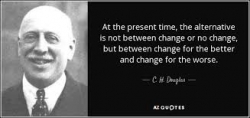
Systems that aim to organise people can be placed into one of two groups; systems that limit peoples' freedoms and those that increase them. The latter philosophy is the foundation of the Social Credit movement conceived by the Anglo-Scottish Engineer Major Clifford Hugh Douglas.

When trying to grasp the Social Credit approach to economic matters, it is important to keep the following three principles in mind...

As this is the inaugural blog entry for 'The Clifford Hugh Douglas Institute for the Study and Promotion of Social Credit’, it seemed fitting to deal upfront with the central question which invariably preoccupies the minds of most newcomers to the subject: what exactly is Social Credit?

Latest Articles

  • The Accounting of Abundance: A Structural Critique of Inflationary Theory
    Mainstream economic thought treats inflation as a phenomenon of monetary volume—the "Too Much Money" paradigm. However, by applying the engineering logic of C.H. Douglas’s A+B Theorem, we can deduce that inflation is not primarily a result of consumer behaviour, but a mathematical consequence of debt-based cost accounting in an industrial society.
    Written on Saturday, 14 February 2026 12:56 Read more...
  • A Douglas Social Credit Critique of Gesell’s Monetary Analysis and Proposals
    Silvio Gesell believed that the two great economic evils were stagnation and inequality. He attributed stagnation to hoarding (the “retention” of money that slows circulation) and inequality to both hoarding and the payment of interest on money. His remedies were therefore twofold: demurrage (a carrying charge that makes money lose value if held, forcing it into rapid circulation) and interest-free credit. From a Douglas Social Credit standpoint, Gesell’s take on monetary reform rests on a fundamentally flawed diagnosis and thus the remedies he proscribes are inadequate, in addition to being coercive and counterproductive.
    Written on Tuesday, 10 February 2026 14:00 Read more...
  • THE THEOLOGY OF THE INHERITANCE: A Social Credit Synthesis of Patristic Thought and Economic Reality
    Social Credit stands alone in its pursuit of the Economics of Grace. It recognizes that the "price" of our life has been paid by the gifts of God and the genius of our ancestors. By replacing the bondage of the gold standard and the indignity of the Job Guarantee with the National Dividend and the Price Discount, we move from an "Economics of Toil" to an Economics of Leisure.
    Written on Tuesday, 10 February 2026 07:54 Read more...