


I. The Patristic Foundation: The World as Gift
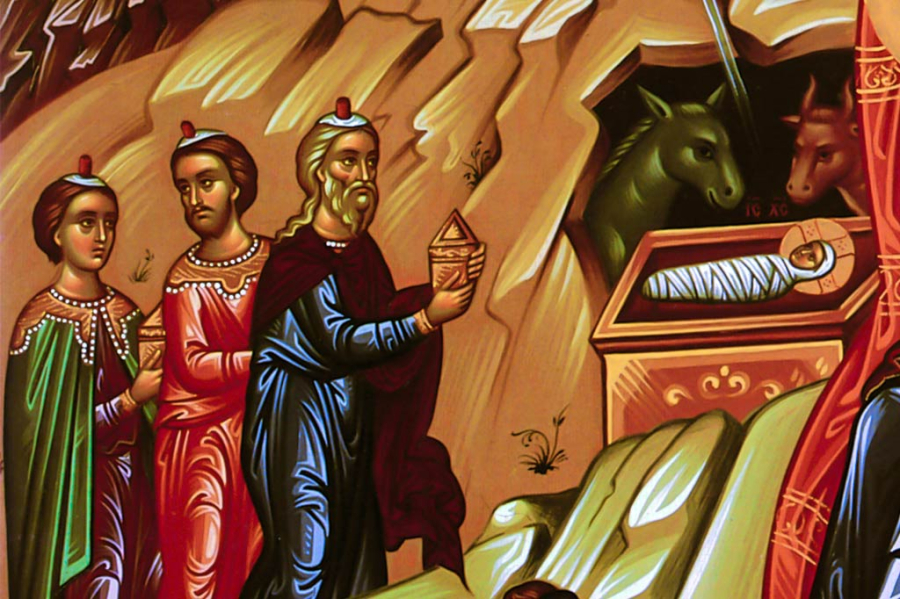
In Orthodox theology, the world is a Liturgy of the Gift. The Church Fathers—most notably St. Basil the Great, St. John Chrysostom, and St. Ambrose of Milan—taught that the "Wealth of the World" is a common heritage provided by God for all humanity.
"The earth is the Lord's and the fullness thereof. If you say you have it from your ancestors, you are like a man who took a seat in the theatre and then tried to keep out those who came later, claiming that what was for everyone's use was his own."
— St. Basil the Great
"Tell me, then, whence art thou rich? From whom didst thou receive it? ... 'The earth is the Lord’s, and the fulness thereof.' This then is the ground of all the evil, that men possess as their own the things that are the Lord’s."
— St. John Chrysostom
Under this "Cosmic Economy" (oikonomia), wealth is not merely a product of individual toil; it is the fruit of God’s grace and the collective effort of the "cloud of witnesses"—the generations that preceded us.
II. The Cultural Heritage: The 95% Factor
Social Credit identifies the Cultural Heritage as the primary factor of production. This includes the cumulative discoveries of humanity: the wheel, the steam engine, electricity, and automated systems.
- The Estimate: It is estimated that 95% of our productive capacity (GDP) is now attributable to this inherited "Common Stock" of knowledge and machine power, rather than current human exertion.
- The Logic: If a field that once required 100 men to harvest is now harvested by one man and a machine, the vast majority of that output is the "unpaid labor" of the inventors of the past. The wealth produced is a Social Product, yet our financial system still attempts to distribute it primarily through "Wages for Work."
III. The Monetary Circuit: Creation and Destruction
Money in a modern economy is not a commodity, but a system of accounting.
- Creation: Banks create money through the act of expanding their balance sheets. New money enters the economy whenever a bank issues a loan, purchases an asset, or spends on its own ordinary business expenses. In each case, a new deposit is created that did not exist before.
- Destruction: When a loan is repaid or a bank sells an asset back to the public, that money is destroyed—it is cancelled out of the ledger.
IV. The Douglas A+B Theorem: The Deficit of Power
Major C.H. Douglas observed a fundamental "glitch" in industrial accounting:
- Group A: Payments to individuals (wages, salaries). This is current purchasing power.
- Group B: Payments to other organizations (raw materials, overhead, machinery). These costs represent past consumption—wealth used up in a previous cycle.
- The Theorem: The total price is A + B. However, money represented by B has already flowed back into the banking system to cancel previous debts; it is not available as income.
- The Debt Trap: Because the community is only given A to buy a product priced at A + B, the system can only function through ever-increasing aggregate debt. New loans must be taken out simply to provide the extra "tickets" needed to clear the shelves of goods already produced.
V.The National Dividend: The Right of the Heir
As technology—particularly Artificial Intelligence—displaces human labor, the "Wages for Work" model collapses. If the machine does the work, and income is only tied to work, the community is starved amidst plenty.
- The Necessity: AI and automation represent the ultimate maturation of the Cultural Heritage. They are not the property of a few "tech giants," but the fruit of millennia of human language, mathematics, and logic.
- The Justification: The National Dividend is the financial recognition of every citizen's status as a Co-Heir to this heritage. It is a periodic payment issued to all, not as charity, but as a rightful share of the "Social Product."
VI. Debt-Free Creation: The Gift of Grace vs. Works-Based Debt
The most critical distinction of Social Credit is the mode of money creation. In our current system, almost all money is "Debt-Money"—it is born as a liability that must be justified through toil. This is a secularized form of Works-Based Salvation, where every "ticket" to participate in life must be "earned" through servile labor, even when that labor is no longer physically necessary.
- The Theology of Grace: The money issued for the National Dividend and the Price Discount is created Debt-Free. This is the financial embodiment of Grace. It is a gift that recognizes the abundance already provided by God and our ancestors.
- Ending the Aggregate Debt: Because this money is debt-free, it fulfills the mathematical requirement of the A+B theorem without creating a new debt-burden. It provides the "missing money" (B) as a gift to the community, thereby negating the necessity of going further into aggregate debt simply to maintain the current system. Grace cancels the debt-treadmill.
VII. Real Cost and the Just Price
Social Credit defines Real Cost not in terms of financial digits, but in terms of physical reality. The real cost of production is the total consumption incurred during the same period.
- The Observation: If we produce $100 worth of goods but only consume $75 worth of resources to do so, the "Real Cost" to the community is only $75.
- The Logic: Charging the full $100 financial cost (which includes B-costs) creates a surplus of goods that cannot be bought. The Just Price (Real Price) should reflect the ratio of Total Consumption to Total Production.
VIII. The Price Discount Mechanism
Social Credit proposes to bridge the gap through the Compensated Price.
- The Mechanism: An item with a financial cost of $100 is sold for $75 (the Real Price). The retailer is reimbursed the remaining $25 by the National Credit Office using new, debt-free money. This ensures that the total price of all goods produced is exactly equal to the total money available to consumers.
Conclusion: The Great Departure from the Economics of Toil
Virtually every established school of economic thought—be it Classical Economics, Marxism, or Keynesianism—shares a common, unexamined dogma: the cult of "Full Employment." Whether they advocate for the "unseen hand" of the market, the state ownership of the means of production, or government spending to stimulate demand, they all view work as an end in and of itself. They demand that man be tethered to a machine or a desk to justify his daily bread, regardless of whether that labor is physically required. This is an economics of the Law, a secularized Works-Based Salvation that ignores the reality of the technological gift.
Social Credit stands alone in its pursuit of the Economics of Grace. It recognizes that the "price" of our life has been paid by the gifts of God and the genius of our ancestors. By replacing the bondage of the gold standard and the indignity of the Job Guarantee with the National Dividend and the Price Discount, we move from an "Economics of Toil" to an Economics of Leisure.
This transition is not an invitation to idleness, but a liberation for Hesychia (stillness) and Theosis (union with God). When man is freed from the frantic necessity of "earning" his survival in a world of automated abundance, he is finally at liberty to fulfill his true vocation. He can use his time for religious pursuits, artistic creation, and self-fulfillment. A world where citizens are free to serve God and pursue their true vocations—unburdened by the artificial scarcity of a debt-ledger—is a world being healed. We move from the bondage of the debt-trap into the "glorious liberty of the children of God," where the financial tickets finally reflect the true abundance of the physical harvest.
