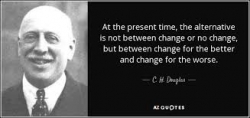
The modern, industrial system possesses an enormous productive capacity, both actual and potential, to meet our legitimate needs for goods and services. With every technological advancement we can produce more and/or better with less resource consumption and less human labour.

What is Social Credit? I have often been asked to explain it in a nutshell. So, as far as the purely economic aspects of Social Credit are concerned, here it goes

The following article will be published in the first edition of the Portuguese Journal "Libertária"

Wednesday, 04 March 2015 19:21

The Social Credit Angle

Systems that aim to organise people can be placed into one of two groups; systems that limit peoples' freedoms and those that increase them. The latter philosophy is the foundation of the Social Credit movement conceived by the Anglo-Scottish Engineer Major Clifford Hugh Douglas.

When trying to grasp the Social Credit approach to economic matters, it is important to keep the following three principles in mind...

As this is the inaugural blog entry for 'The Clifford Hugh Douglas Institute for the Study and Promotion of Social Credit’, it seemed fitting to deal upfront with the central question which invariably preoccupies the minds of most newcomers to the subject: what exactly is Social Credit?

Latest Articles

  • The Ghost in the Ledger: How Financial Depreciation Double-Charges Society for Physical Capital
    Modern industrial society suffers from a profound economic paradox. While the real, physical cost of constructing capital assets is fully expensed and liquidated at the exact moment of completion, orthodox financial accounting bottles this cost up on corporate balance sheets, pushing it into the future as an ongoing debt burden. By forcing consumers to pay for capital depreciation through retail prices long after the physical resources have been consumed, the financial system structurally starves the public of purchasing power. This systemic flaw was first comprehensively exposed by engineer and macroeconomic thinker C. H. Douglas. By bridging the engineering-based insights of Douglas’s Social Credit framework with contemporary accounting realities, this essay demonstrates how the divergence between thermodynamic reality and bookkeeping conventions drives systemic economic crises, forcing the community to buy back its own productive capacity twice.
    Written on Thursday, 08 October 2026 15:51 Read more...
  • The Creditary Nature of Money in Post Scarcity
    The Austrian School of economics maintains that money originated as a high-saleability commodity selected by market forces to reduce barter friction, treating credit as a secondary mechanism backed by pre-existing physical savings. This paper demonstrates that the Austrian foundational model rests on dual empirical and operational fallacies: the myth of commodity money and the myth of absolute physical scarcity. Drawing on A. Mitchell Innes’s credit theory of money, modern balance-sheet mechanics, C.H. Douglas’s Social Credit analysis, and the realities of modern industrial capacity, we show that money has always been credit—a system of clearing debt—and that credit creation precedes both savings and physical production. In a technological era characterized by systemic capacity abundance, holding to gold-standard or loanable-funds assumptions misdiagnoses the nature of financial capital, misunderstands the true drivers of inflation, and severely distorts macroeconomic analysis.
    Written on Sunday, 23 August 2026 12:14 Read more...
  • Morality, Douglas Social Credit, and Economics
    It is possible to frame the Douglas Social Credit diagnosis for our financial and economic woes, as well as its remedial proposals for monetary reform in the common interest of the citizenry, in terms of morality. Like the thread of Ariadne that led Theseus through the labyrinth of the Minotaur and safely out again, a specific understanding or conception of morality can serve as the fil conducteur—the guiding thread—which unfolds the DSC diagnosis and remedial proposals step by step in a systematic, logical way. Yet the deeper reason this moral framing actually succeeds as an explanatory heuristic is that the DSC model is itself endogenously moral: morality is not to be applied to the system from outside by the action of some agent (who presumably directs the system to moral as opposed to immoral ends); rather, morality is built right into the ordinary operating structure and everyday functioning of the…
    Written on Thursday, 06 August 2026 08:02 Read more...